

Introduction
Qualitative recruitment is an important part of field research because it helps researchers identify and engage participants who can provide rich, detailed, and relevant information. In qualitative studies, recruitment is usually based on specific social characteristics, experiences, or behaviors that match the objectives of the research.
To achieve the required number of participants, recruitment can be conducted through different channels such as social media platforms, community networks, and referrals. Social media recruitment is particularly useful because it allows researchers to reach a wide and diverse audience quickly and efficiently. Platforms such as Facebook, WhatsApp, Instagram, and LinkedIn can be used to share study information and invite interested participants.
Recruitment may also focus on different social classes to ensure diversity and balanced representation within the study. This helps researchers gather perspectives from people with varying economic, educational, and social backgrounds. In addition, demographic factors such as age, gender, occupation, and location may be considered depending on the research objectives.
Effective qualitative recruitment requires clear communication, ethical consideration, confidentiality, and informed consent to ensure participants feel comfortable and willing to share their experiences openly.
Effective Qualitative Recruitment Requirements
Qualitative research involves collecting detailed opinions, experiences, and feelings from participants. Because of this, recruitment must be done carefully and ethically to ensure reliable results and protect participants.
The following are important requirements for effective qualitative recruitment.
1. Clear Communication
Researchers should communicate clearly with potential participants so they fully understand the study.
This includes explaining:
- The purpose of the research
- Why the participant has been selected
- What activities will be involved
- The expected duration of participation
- Any possible benefits or risks
Clear communication helps participants make informed decisions and builds trust between the researcher and participants. Researchers should use simple and understandable language, avoiding technical terms that may confuse participants.
Example: A researcher studying students’ experiences with online learning should clearly explain that participants will take part in interviews discussing their learning experiences.
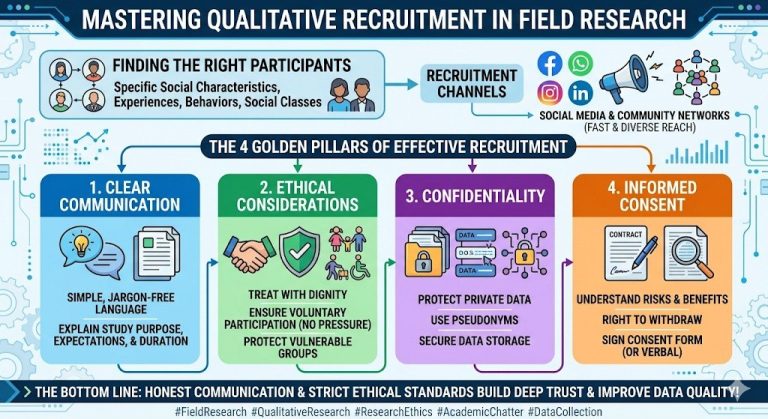
2. Ethical Considerations
Ethics are essential in qualitative recruitment because research often deals with personal experiences and sensitive information.
Researchers should:
- Treat participants with respect and dignity
- Avoid discrimination or coercion
- Ensure participation is voluntary
- Protect vulnerable groups such as children or people with disabilities
- Obtain approval from relevant ethics committees when necessary
Ethical recruitment ensures that participants are not harmed physically, emotionally, socially, or psychologically during the research process.
Example: Participants should never be forced or pressured into joining a study because of authority, friendship, or financial influence.
3. Confidentiality
Confidentiality means protecting participants’ private information from unauthorized access or disclosure.
Researchers should:
- Keep personal details secure
- Use codes or pseudonyms instead of real names
- Store data safely
- Share findings without revealing identities
Maintaining confidentiality encourages honest responses because participants feel safe discussing personal experiences.
Example: If participants discuss sensitive topics such as family problems or health issues, their identities should not appear in reports or publications.
4. Informed Consent
Informed consent means participants willingly agree to participate after understanding all important details about the study.
Researchers should provide information about:
- The aim of the study
- Procedures involved
- Possible risks and benefits
- The right to withdraw at any time
- How information will be used
Consent may be written or verbal depending on the research setting. For minors, consent from parents or guardians may also be required.
Example: Before conducting interviews, the researcher may ask participants to sign a consent form confirming that they understand the study and agree to participate voluntarily.
Conclusion
Effective qualitative recruitment depends on honest communication, ethical behavior, protection of participant privacy, and proper informed consent procedures.
These requirements help build trust, improve the quality of data collected, and ensure that research is conducted responsibly and professionally.
Note: This post was submitted by Judith Musyoka, Research Executive, Infinite Infinite.